California's Abusive Conduct Law
Is a Cautionary Tale
Effective workplace bullying legislation is a key goal of the various anti-bullying advocacy movements in the United States. Unlike civil rights legislation, the framework for worker abuse legislation is status-blind rather than defined as class-based. However, unlike violence in the home, the various advocacy factions, the legislators they court, and the business community that frames the issue in the United States have employed various language games to avoid addressing this devastating form of workplace abuse that continues to grow and contributes to suicide and gun violence (Dept. of Labor, 2026).
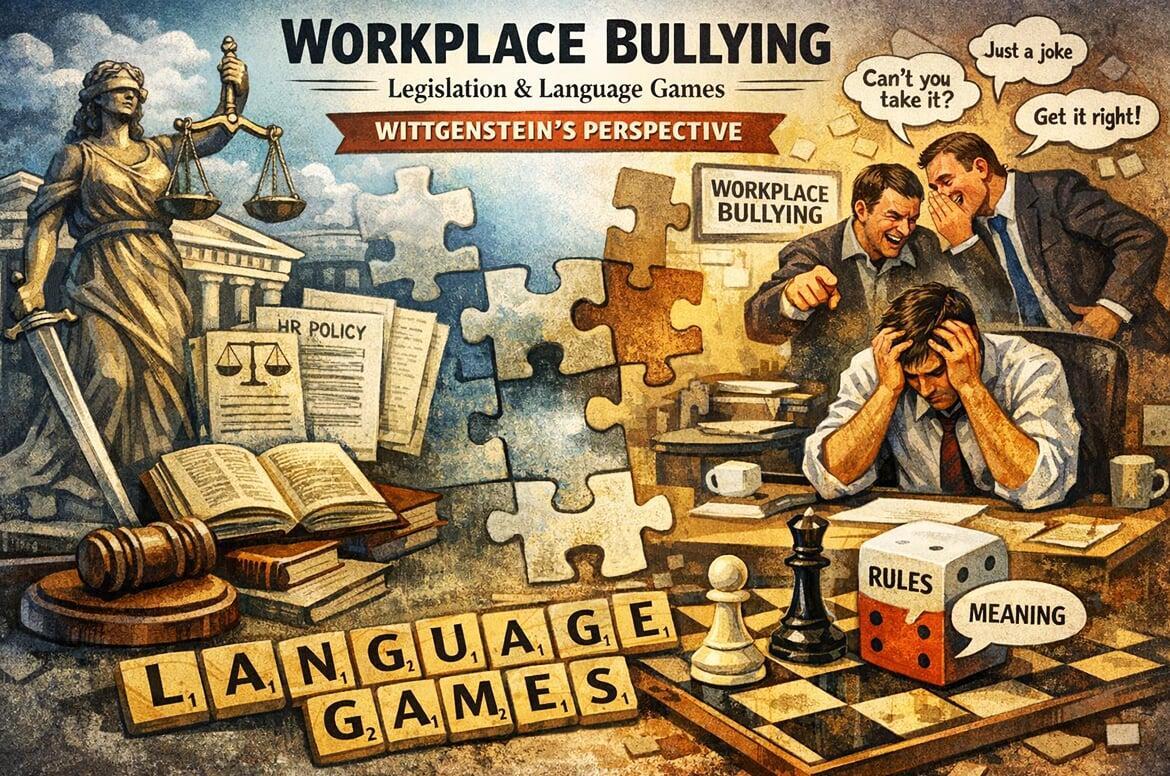
Specific terms have come to dominate the ongoing conversations around workplace bullying in the United States. On the one hand, we, as a society, need to clarify the meanings of terms that affect the public good. In particular, these meanings help us pass legislation that creates legal precedent concerning harm to individuals, businThe concept of the language game was presented by the Austrian-British philosopher Ludwig Wittgenstein (1889-1951). Wittgenstein's main argument concerning language games was that "the meaning of a word is its use in the language." This usage is not fixed. Instead, meaning is conveyed through context and use in special situations, or through an activity learned through practice or experience. Wittengenstein also famously argued that the limits of language define the limits of the world, stating, "What we cannot speak about, we must pass over in silence" (Biletzki, 2021).
Specific terms have come to dominate the ongoing conversations around workplace bullying in the United States. On the one hand, we, as a society, need to clarify the meanings of terms that affect the public good. In particular, these meanings help us pass legislation that creates legal precedent concerning harm to individuals, businesses, and institutions. On the other hand, the unexamined use of these words has already created opportunities for obfuscation with legislators and competition among activists.
Nine language games are briefly reviewed in this essay. These language games concern the following terms: “justice for all,” definitions of workplace bullying (also known as abusive conduct, mobbing, or harassment and discrimination), "with malice," psychological safety, psychosocial safety, the application of proposed legislation, inclusions and exclusions for targets of workplace bullying, policy backdoors, and organizational health and wellness programs. The policies represented in this essay specifically concern those developed by the institution where I was severely bullied and where I am now supporting another individual facing institutional harassment. Thus, this essay attempts to address these language games to broaden both the conversation and awareness.
Language Game #1: With Justice for All.
There is a story I want to share about the language game that accompanies the Pledge of Allegiance, which we were taught as students to recite each morning at school. I remember proudly standing at the side of the desk, hand over my heart, as I repeated these solemn words about "Liberty and Justice for All." I really believed it, and it made me feel proud of my country as a little girl in grade school.
It wasn't until I was severely bullied and attended a city council meeting where I was to accept an anti-bullying proclamation from the city government that the language game meaning of these words hit home. We all stood to say the Pledge, and when those words came up in the recitation, I almost fainted. I realized that there was no avenue for justice for me, even though I had done nothing wrong. All I had done was try to do my job to take care of myself and my family. The Professor had taken all of that away from me for her own selfish ends. The law was not going to protect me from this unfair damage to my career, reputation, health, and retirement.
Language Game #2: Workplace Bullying
Workplace bullying has been referred to as abusive conduct, mobbing, and harassment in various definitions over the years. Schoolyard bullying was first researched in the late 1970's by Swedish-Norwegian Dan Olweus. Swedish-German researcher Heinz Leymann identified mobbing as an adult form of bullying and terror in the 1980s. Leymann also characterized the phenomenon as a group action that occurs against one person. Workplace bullying was coined as a term in 1992 by Andrea Adams, an English activist who wrote the book Bullying at Work. The definition has acquired additional descriptive words over the years, and various researchers have identified behaviors that have been excluded.
The current definition that has "taken hold" and is most often referenced in the United States was developed by the Workplace Bullying Institute. This definition is:
…repeated, harmful mistreatment of an employee by one or more employees; abusive conduct that takes the form of verbal abuse, (physical and nonverbal) behaviors that are threatening, intimidating or humiliating, work interference or sabotage, or in some combination.
The term "abusive conduct" for workplace bullying was also used in conjunction with the efforts by Dr. David Yamada and Dr. Gary Namie to pass the Healthy Workplace Bill from 2003 until 2025, when a new bill was introduced. This early definition of workplace bullying as abusive conduct was adopted by California in a "training law," but with a twist.
Language Game #3: "With Malice"
In 2014, California's legislature adopted the definition of abusive conduct for workplace bullying used in the Healthy Workplace Bill. While many of the basic behavioral constructs of bullying are encompassed in the definition, a language game has effectively rendered the code useless. Abusive conduct is defined by the California Government Code, Section 12950.1, as: "workplace conduct, with malice, that a reasonable person would find hostile, offensive, and unrelated to an employer's legitimate business interests."
Note the addition of the words "with malice" in the legislative rendition of the definition. As far as anti-bullying legislation, this law could have been a ground-breaking advance in the ability of workers to protect themselves from undeserved abuse in the workplace, and for workplaces, in general, to become less toxic. The definition is broad enough to include the acts of manipulation, gaslighting, and sabotage, along with the more common bullying behaviors, such as yelling, screaming, throwing things, denigration, calling people names, and the like. The definition, published in California Government Code Sec. 12950.1, was a key part of Assembly Bill 2503, legislation that required a segment in sexual harassment training to include (at a minimum) information on workplace abuse for employers with 5 or more employees. However, the reality is that the legislation has been more disappointing than helpful because of the "malice" addition, and it is here that the language game reveals itself.
Essentially, the legal standard of "malice" requires a publication of a false defamation that the author knowingly uses to slander the target. The language game here is that bullying at work is not about publishing false statements about a targeted employee. Bullying is both covert and overt, with the overt part most commonly enacted as a direct power abuse play between a more powerful and a less powerful person, while the covert part is what really harms workers the most. Why? Most people do not believe the target when they try to expose the manipulations that are taking place. No one is pre-publishing these specific manipulations in the office encounters, and the common law usage of malice has not been argued here. The end result of this language game is that using the words "with malice" wipes out any effective use of the "hostile, offensive, and unrelated" conduct that makes the toxic workplace experience feel like a torture chamber.
Language Game #4: Psychological Safety
The main example of this language game is the adoption of the term "psychological safety" as a legislative effort to refer to the preferred state of the work environment when compared to toxic, abusive environments. This concept was briefly considered and rejected by the Rhode Island legislature in 2024, prompting Drs. Amy Edmondson and Michaela Kerrissey (May 9, 2025) to write an article contesting misguided beliefs in mandating its use through legislation. Dr. Edmondson is a Harvard business professor who conducted a team study in 1999 that found psychological safety was a key aspect of efficient and creative teams. In this article, psychological safety is defined as:
…a shared belief that the team is safe for interpersonal risk taking. ..The term is meant to suggest neither a careless sense of permissiveness, nor an interpersonal risk-taking, but rather a sense of confidence that the team will not embarrass, reject, or punish someone for speaking up. This confidence stems from mutual respect and trust among team members. (p. 4)
The term originated during a period of increased interest in understanding and developing learning organizations, a concept promoted by Peter Senge in the 1990's with the publication of his book, The Fifth Discipline. The term psychological safety also originated in the context of the rapid technological challenges of the 1990s. The construct of "feeling safe" refers to modeling and facilitating a container space that enables employees to adopt learning behaviors amid the challenges posed by this rapid change, such as learning new computer applications, adopting new marketing approaches, and interfacing with international teams. Additionally, the expectations for instilling psychological safety were aimed at leadership, who were expected to help create an environment where people could speak up and challenge processes that didn't work.
The greatest misconception about psychological safety is that it can be established through policy. In research studies, psychological safety is an organizational culture issue that arises from interactions among organizational members. As Dr. Edmondson explained (2025), "
It doesn't sound terribly scientific because, in a way, it isn't. But learning behaviors are usually discretionary, somewhat effortful, and potentially embarrassing. They bring interpersonal risk. Saying, 'I need help. I'm not sure what to do here,' is a learning behavior."
The shift in the "language game" surrounding psychological safety marks a significant transition from its academic roots as a catalyst for learning to its contemporary use in legislative efforts targeting toxic workplace behaviors. The original research focuses on the need for leadership to foster a climate in which team members can take interpersonal risks to improve organizational performance. The interactional environment of team cohesion is what supports the individual's ability to take chances at key moments. Current legislative movements, such as the Workplace Psychological Safety Act (WPSA), flip the avoidance of the negative individual outcome as the purpose, redefining the term as a legal protection against psychological abuse, bullying, and mobbing. This "flipping" is becoming the current understanding of the term, and the act of flipping promotes the false expectation that this construct can be legislated into existence.
Language Game #5: The Academic vs. Legislative "Language Game"
The academic definition and the emerging legal application of psychological safety start from fundamentally different premises: As defined by Dr. Edmondson, psychological safety is the shared belief that a team is safe for interpersonal risk-taking, such as admitting mistakes or asking for help. It is built interaction by interaction through leaders modeling vulnerability and responding productively to failures to drive innovation.
In a legislative context, the focus flips to the lack of safety as a starting point. Proposed laws like the WPSA aim to prohibit psychological abuse—defined as conduct that results in the violation of an employee's right to a psychologically safe work environment. This shifts the focus from "learning" to "prevention of harm," causing confusion about the term's meaning.
Legislative Challenges and "Equivalence"
The difficulty in establishing a standard legal "equivalence" for psychological safety stems from several variables:
- Subjectivity and Individual Background: Legislative efforts must grapple with the fact that psychological distress is often defined by what a "reasonable person" would suffer. For instance, California's SB 428 (effective January 1, 2025) defines harassment as conduct that would cause a reasonable person to suffer "substantial emotional distress." This focus on psychological distress also does not encompass the very real physical harm caused by constant stress from the abuse.
- Construct Ambiguity: Experts argue that psychological safety is not a "lever" that can be pulled by policy alone; telling a team they must have it "or else" is unlikely to produce the intended climate of candor. As Dr. Yamada pointed out in a blog on the proposed legislation, it also sets the stage for confusion among team members about what constitutes an incident that harms psychological safety (https://newworkplace.wordpress.com/2025/05/).
- Conflict with Performance Standards: Some research suggests that while psychological safety is critical for creativity, "too much" of it might harm performance in routine jobs such as nursing, where following strict rules is essential. This worksite variation complicates the creation of a "one-size-fits-all" mandate.
Language Game #6: Psychosocial Safety
The term most applicable to workplace bullying, harassment, and discrimination is the construct "psychosocial safety" (Law et al., 2021). The National Institute for Occupational Safety and Health (NISOH) defines this construct with a focus on the environmental factors rather than on mandating psychological safety as a general container. Psychosocial hazards are defined as "… factors in the work environment that can cause stress, strain, or interpersonal problems for the worker " (NIOSH, 2024). These include:
- Job Design: Work overload, lack of control, and role ambiguity.
- Organizational Factors: Downsizing, poor policies, and inadequate staffing, and
- Social Context: Lack of support from supervisors or coworkers and workplace violence or bullying (NIOSH, 2024).
This term has also been extended to a focus on the Psychosocial Safety Climate (PSC) of the worksite. Psychosocial safety climate (PSC) is defined as shared perceptions of organizational policies, practices, and procedures for protecting workers' psychological health and safety, largely stemming from management practices (Law et al., 2021).
As a theory, PSC builds on and extends the Job Demands-Resources (JD-R) framework, which holds that employee well-being arises from a combination of job demands (physical/mental effort) and job resources ( and autonomy). The JD-R framework also supports the proposition that organizational-level PSCs determine work conditions and, subsequently, psychological health problems and work. Under this framework, factors of psychosocial hazards that cause stress, strain, or interpersonal problems are: work organization, shiftwork, long work hours, fatigue, violence, bullying, and incivility.
NIOSH and the Centers for Disease Control and Prevention (CDC) have developed a framework for psychosocial safety called "Total Worker Health®." This framework integrates protection from work-related safety and health hazards with the promotion of injury and illness prevention. It focuses on how the design and organization of work affect physical, psychological, social, and economic well-being. The model also prioritizes organizational-level changes over individual-level coping strategies to create a more sustainable and effective impact. However, this approach lacks the legislative reach to apply these protections to the millions of worksites in the United States, especially given the current administration's lack of support for workers.
Language Game #7: Proposed Legislation Inclusion and Exclusion
The latest version of Dr. David Yamada's efforts is the Workplace Bullying Accountability Act (WBPAA). This proposed legislation centers on the workplace taking primary responsibility for addressing workplace abuse. In this manner, the legislation mirrors the Workplace Violence Policy Act (WVPA) recently adopted in California. As one of my clients pointed out, the problem with both the WBPAA and WPSA legislation is that the protections are not broad enough. The proposed law does not include volunteer or internship jobs. This point should be seriously considered, as the job and career landscape is changing with the introduction of AI technology, and positions such as these may become even more valuable stepping stones to employment in the near future. My client performed a key elected community volunteer role. Even though the bullying outcome severely damaged their community standing, their health, and their business, recognition of the damage and the right to seek justice would not be covered under this law or other proposed legislation currently being promoted for consideration.
Language Game #8: Policy Backdoors
Policies are not sacrosanct. Many policies ignore the basic premises required to address and handle workplace bullying. A complete policy would not only define the abuse, but it would also handle how the complaint was made, illustrate a neutral and trauma-informed investigation process, note how the parties to the complaint would be kept safe during the investigation, detail report issues that must be handled, and provide for real consequences as part of the outcome.
In reality, most policies do not go much further than a definition of bullying that may or may not apply to the situation. Some of them get by with a statement that the behavior(s) are not allowed. This is not a policy. This is a vague statement standing in for a rule that does nothing.
I recently conducted a review of policies at UC Berkeley, where workplace bullying policies and reporting portals have been developed since 2010. As I reviewed these policies and the attached ethics documents, it was no surprise to me that, at some point in the relevant policy, a back door appears. Usually, the definition is narrowly and specifically defined to mimic the schoolyard version of bullying (Language Game #1). The focus on harassment also leaves the retaliatory and fraudulent bait-and-switch tactics and manipulative grant behaviors unaddressed.
(chrome-extension://efaidnbmnnnibpcajpcglclefindmkaj/https://policy.ucop.edu/doc/4000701/AbusiveConduct)
These policies also often lack a list of consequences or actions to protect or provide justice to the aggrieved complainant, leaving those issues to another organizational body to handle or decide. For example, the whistleblower's complaint filed with the Chancellor's office is forwarded to the UC Police Department (UCPD) (https://hr.berkeley.edu/policies/policies-procedures/university/whistleblower). If you are whistleblowing about the lack of police accountability, how does that help?
The UCPD was fined $2.4 million in 2022 for missing entries in case logs and misclassification of 1,125 crimes – primarily Cleary Laws. (11/25/25, https://www.ed.gov/about/news/press-release/us-department-of-education-initiates-review-of-university-of-california-berkeley-potential-clery-act-violations#:~:text=UC%20Berkeley%20has%20a%20history,and%20insufficient%20public%20crime%20logs.) According to the Chancellor's website, "
The Jeanne Clery Campus Safety Act is a federal law that requires every higher education institution to collect and publish statistics on the specific list of crimes you see below. The disclosure of these statistics is intended to raise safety awareness at the institution and, in turn, make the campus safer."
For a detailed list of these crimes, go to https://chancellor.berkeley.edu/clery-act-compliance/clery-crimes-and-locations#. Under-reporting these crimes leaves not only the campus but the entire Berkeley community at risk.
I am currently supporting a former UCPD employee who reported that the department continues to underreport Clery crimes. This under-reporting constitutes fraud against the Department of Education. For universities and colleges to receive federal funding from the Department of Education, they are required by the Clery Act to report Clery crimes accurately.
This lack of reporting provides the community with a false sense of safety because now these random and violent crimes do not appear in campus reports. The individual involved felt that it was serious enough to warrant filing a whistleblowing complaint. This individual continued to discover and report other ways the police department was defrauding multiple government agencies. This person even emailed the UCPD Berkeley police chief directly with this information, but never received a response.
The police are not going to investigate themselves, and the union cannot help because it is ensconced within the police department. This individual is now being endlessly hassled by UCPD and the various police, highway patrol, and fire departments in the East Bay. This person is even being harassed by private companies that work closely with law enforcement and fire departments, such as Falk Ambulances in Alameda County, AMR ambulances in Contra Costa They have been fired and forced to move, living in 11 different locations in one year since they left UCPD, Berkeley, due to constant unwanted surveillance and emergency vehicles sounding sirens in a harassing manner in front of or near the places where they stayed.
Another serious Clery Act violation was uncovered separately in a Reddit post asking about the status of bullying at UC Berkeley. One respondent posted a petition/letter about sexual harassment in the Chemistry Department. This letter was addressed to Dean Baranger, Chair Toste, Chief Diversity Officer Yáñez, and Assistant Provost Archer, and signed by no fewer than 786 students. The allegations warrant serious investigation (https://docs.google.com/document/u/1/d/1EWznCXh6s5jEw8XAgtODGQhJwhewNyg-BIrGcvTjyCI/mobilebasic), but it appears nothing has been done. Sexual harassment complaints against UC Berkeley professors are filed with the Office for the Prevention of Harassment and Discrimination (OPHD) (https://ophd.berkeley.edu/), which simultaneously serves as the campus Title IX office. However, once again, the UCPD is the investigating body.
Finally, another "out" is written into the policy about who should decide how these policies are addressed for professors. In a Code of Ethics for Professors and Teaching Assistants, the policy said it was up to the Deans to enforce the policies as they saw fit.
(chrome-extension://efaidnbmnnnibpcajpcglclefindmkaj/https://vpf.berkeley.edu/sites/default/files/guidelines_re_bullying_8.5.19.pdf)
Huh. My bully was a former Dean who hired her replacement and the Assistant Dean. She had hired the HR employee who routed all telephone job interviews directly to the Professor so she could comment on each person who had worked for her. Except for that illegal disclosure, she abused me within the boundaries of the policies in play at that time (2001-2003) through manipulation and non-disclosure. She used her knowledge to bait-and-switch me out of $13,000 in my annual salary, a loss large enough to force me to work weekends just to survive. Six months in, when I finally located the intranet-posted policies explaining what she had done, she had already moved me into a category with no union representation. Now you should be able to understand why nothing was really done about her abusive and fraudulent behavior over the 15 years that she ran her research lab off campus. Everything she did was to skirt the rules, including how she handled the nepotism blocks on hiring, double-dipped on her donations to the school, and committed grant fraud while systematically bullying her financial analysts one after another. I was number 9.
Language Game #9: Organizational Health and Wellness Programs
Andy Regal, author of Surviving Bully Culture: A Career Spent Navigating Workplace Bullying and a Guide for Healing, forwarded the URL link for this particular language game to me from a blog by Vintage Fit, an online wellness program app (https://www.vantagefit.io/en/blog/workplace-wellness-is-a-lie/). The basic question for this language game is: Why aren't workplace wellness programs working? According to the blog, "The answer is simple. Most wellness programs target individual behavior because it's cheaper and avoids confronting organizational issues." (Singh, 2025).
Targeted workers are targeted because they are smart enough and trained enough to know that poor management, unclear expectations, incomplete communication, and a culture that does not support speaking up or solving the real issues create an environment of toxic stress for employees. Awareness is dangerous in environments where leaders and management "look the other way" when it comes to problem-solving or trying to do the right thing.
Conclusion
What we advocate for filters into common language use. The language games discussed in this essay should be explored and open for discussion among advocates, so we do not end up with self-canceling language in definitions and legislation. It behooves advocates and allies to be aware of the way language is manipulated between the various parties if we really want to solve the problem. There are numerous other language games that should be consciously and deliberately addressed as we work towards solving workplace bullying. Another reason we should take extra care exploring these terms and their meanings is to avoid being fooled in backroom negotiations out of sight of those who really need stronger status-blind workers' rights legislation.
References
Adams, A. (1992). Bullying at Work.
Biletzki, A. (First published Fri November 8, 2002; substantive revision Wed October 20, 2021). Ludwig Wittgenstein. Stanford Encyclopedia of Philosophy, https://plato.stanford.edu/entries/wittgenstein/
Cal. Gov. Code § 12950.1 (2025). https://leginfo.legislature.ca.gov/faces/codes_displaySection.xhtml?sectionNum=12950.1.&lawCode=GOV
Edmondson, A. (1999). Psychological safety and learning behavior in work teams. Administrative Science Quarterly, 44(2), 1-8392
Edmondson, A. & Kerrissey, M. J. (May 9, 2025). What people get wrong about psychological safety. Harvard Business Review, May-June 2025,https://hbr.org/2025/05/what-people-get-wrong-about- psychological-safety
Idris, M A., Dollard, M. F., Coward, J., Dormann, C. (2012). Psychosocial safety climate: Conceptual distinctiveness and effect on job demands and worker psychological health, Safety Science, 50(1),19-28, ISSN 0925-7535, https://doi.org/10.1016/j.ssci.2011.06.005. (https://www.sciencedirect.com/science/article/pii/S0925753511001421)
Law R, Dollard MF, Tuckey MR, & Dormann C. (2011.) Psychosocial safety climate as a lead indicator of workplace bullying and harassment, job resources, psychological health and employee engagement. Accid Anal Prev. 2011 Sep;43(5):1782-93. doi: 10.1016/j.aap.2011.04.010. Epub 2011 May 4. PMID: 21658506.
National Institute for Occupational Safety and Health. (2024, April 10). An urgent call to address work-related psychosocial hazards and improve worker well-being. Centers for Disease Control and Prevention. https://www.cdc.gov/niosh/blogs/2024/workplace-psychosocial-hazards.html
Senge, P. M. (1990). The Fifth Discipline: The Art and Practice of the Learning Organization, New York: Doubleday/Currency.
UC Chancellor's Office – page on Clery Crimes
https://chancellor.berkeley.edu/clery-act-compliance/clery-crimes-and-locations#.
UC Policy Links:
https://ophd.berkeley.edu/policies-and-procedures/policies-and-procedures-faculty
(chrome-extension://efaidnbmnnnibpcajpcglclefindmkaj/https://policy.ucop.edu/doc/4000701/AbusiveConduct)
(chrome-extension://efaidnbmnnnibpcajpcglclefindmkaj/https://vpf.berkeley.edu/sites/default/files/guidelines_re_bullying_8.5.19.pdf)
US Department of Education (11/25/2025). Press Release: U.S. Department of Education Initiates Review of University of California, Berkeley for Potential Clery Act Violations, https://www.ed.gov/about/news/press-release/us-department-of-education-initiates-review-of-university-of-california-berkeley-potential-clery-act-violations#:~:text=UC%20Berkeley%20has%20a%20history,and%20insufficient%20public%20crime%20logs.)
US Department of Labor (2/21/2026). DOL Workplace Violence Program. https://www.dol.gov/agencies/oasam/centers-offices/human-resources-center/policies/workplace-violence-program#:~:text=dealt%20with%20appropriately.-,Policy%2C%20Purpose%2C%20and%20Scope,spill%20over%20into%20the%20workplace.
Singh, S. (Dec. 5, 2025). Employees are exhausted, and wellness is just a band-aid. Vintage Fit. https://www.vantagefit.io/en/blog/workplace-wellness-is-a-lie/.
Yamada D. (March 14, 2023). Minding the Workplace: Briefing memo on the Healthy Workplace Bill. https://newworkplace.wordpress.com/?s=Healthy+Workplace+Bill&submit=Search
Yamada D. (May 19, 2025). Minding the Workplace: Harvard Business Review: Leading workplace psychological safety experts oppose psychological safety legislation. https://newworkplace.wordpress.com/2025/05/